The Imaginary Number
Brody Reid —
We learn at school that we can never take the square root of a negative number, right? And it makes sense why we’re taught this because the square root is the inverse of squaring a number, and any number multiplied by itself is always positive. For example, $x = \sqrt{9}$ is asking what number squared gives me $9$? Easy! The solution is $x = \pm 3$ since $3^2 = 3 \times 3 = 9$ and $(-3)^2 = (-3) \times (-3) = 9$. But what about $x = \sqrt{-9}$? Well we’ve hit a wall since no real number (that’s any number on the number line: negatives, fractions, decimals, all of them) multiplied by itself can produce a negative. But do not fret, young mathematician! The hint here is that this is only true for real numbers… so what if we invented new numbers that do produce negatives when squared 😱
Let’s start our journey on the regular number line. The number line is simply all real numbers laid out from $-\infty$ to $+\infty$. It has standard rules for addition and multiplication:
- adding a positive number moves us to the right by the added amount,
- subtracting moves us to the left by the subtracted amount,
- multiplying by a positive number stretches us to the right,
- and multiplying by a negative number flips us to the other side of $0$. For example, starting at $x=3$ and multiplying by $-1$ flips us to $x=-3$.
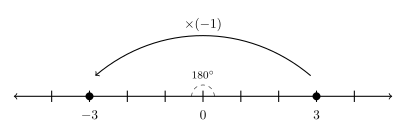
Rule 4 is where we will place our attention from here on out. We will simply consider $-1$ as our exemplary value for “multiplying by a negative”.
We normally think of multiplying by $-1$ as just “making a number negative.” But it’s equally convenient to think of it as making a $\boldsymbol{180^\circ}$ rotation around $\boldsymbol{0}$. So $3 \times (-1) = -3$ means we swept $180^\circ$ around $0$. That means that multiplying by $-1$ twice produces two half-turns, or a full $360^\circ$ rotation, taking us back to where we started. For example,
$$ \begin{align} &3 \times (-1) \times (-1) \\ &= (-3) \times (-1) \\ &= 3 \end{align} $$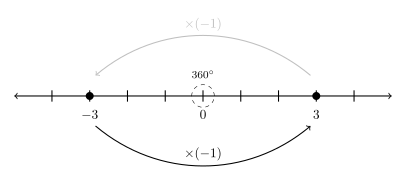
Ok, so if multiplying by $-1$ twice is a full rotation, and multiplying by $-1$ once is half of a rotation… can we do a quarter rotation? At first glance, no, since a $90^\circ$ rotation doesn’t land on the number line at all: that would be perpendicular to the number line, pointing straight up into space that doesn’t exist 😳 But let’s imagine that it is possible. Then there must exist some number $x$ that, when multiplied by itself, gives $-1$. In other words, multiplying by $x$ twice would be the same as multiplying by $-1$ (a $180^\circ$ rotation) and multiplying by $x$ once would make a $90^\circ$ rotation into our new vertical dimension.
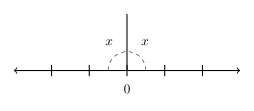
We have just invented the imaginary number!
$i$ is defined to be the number that when multiplied by itself gives $-1$, that is
$$ i^2 = -1 \implies \boxed{i = \sqrt{-1}} \, . $$Job done! Great work 😊
However… we have a slight problem. We need somewhere for a $90^\circ$ rotation to land, since at the moment, we only have the horizontal direction of our number line. Well why don’t we extend the number line with a new vertical axis made of imaginary numbers (multiples of $i$)! This creates a two-dimensional plane where the horizontal axis is real and the vertical axis is imaginary. This way, when we multiply a real number by $i$ (quarter turn), we will land on our new vertical axis. For example, if we start at $2$ and multiply by $i$ we land on $2 \times i = 2i$, which is indeed a $90^\circ$ rotation!
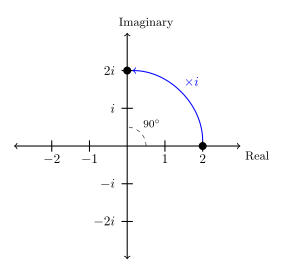
And if we instead multiply $2$ by $i$ twice, we will make a $180^\circ$ rotation since
$$ \begin{align} 2 \times i \times i &= 2 \times \underbrace{i^2}_{-1} \\ &= 2 \times (-1) \\ &= -2. \end{align} $$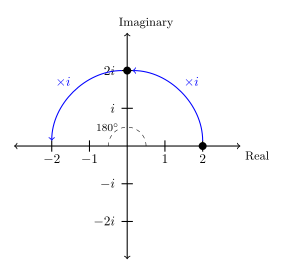
And just like that, we’re inventing math!
Let’s continue on our journey and see what happens when we keep multiplying by $i$. Say we start at $1$ and multiply by $i$ repeatedly, what will happen?
- $i^1 = i \ $ (a $90^\circ$ turn, pointing up the imaginary axis)
- $i^2 = i \times i = -1 \ $ (another $90^\circ$, pointing left along the real axis)
- $i^3 = i^2 \times i = -1 \times i = -i \ $ (another $90^\circ$, pointing down the imaginary axis)
- $i^4 = i^3 \times i = -i \times i = -i^2 = 1 \ $ (one more $90^\circ$, and we’re back where we started!)
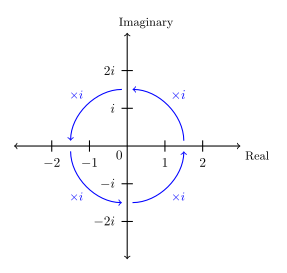
After four quarter turns we’ve made a full $360^\circ$ rotation and landed right back where we started at $1$. And that’s what $i$ does! It rotates! So there you have it. What started as a seemingly impossible question, what is the square root of a negative number?, led us to invent an entirely new dimension of numbers. And we didn’t just make up some abstract nonsense: $i$ has a beautiful geometric meaning as a $90^\circ$ rotation, elegantly extending the number line into a full two-dimensional plane. Not so “imaginary” in my books 😊
Check out this video for another great explanation of $i$.