Squaring Both Sides
Brody Reid —
When tutoring high school students in math I would often encounter misunderstandings about how to isolate variables in monomial equations. I would commonly hear, “can we just move the variable to the other side?” The answer is yes, but this is an incomplete understanding of what is happening to the value we are “moving.” What we are doing, I would explain to them, is multiplying by the same value on either side (or more generally, we are applying the same operation to both sides). Hence why the value seems to move from one side to the other. Let me present an example. Let’s say we have the following equation
\[ \left| \sin x \right| = \frac{\sqrt{y}}{2} \]and we want to isolate for $y$. Our first step will be to multiply both sides of the equals sign by 2.
\[ \begin{align} 2 \left| \sin x \right| &= 2 \left( \frac{\sqrt{y}}{2} \right) \\[0.25em] 2 \left| \sin x \right| &= \cancel{2} \left( \frac{\sqrt{y}}{\cancel{2}} \right) \\[0.25em] 2 \left| \sin x \right| &= \sqrt{y} \tag{1}\label{eq:1} \end{align} \]And just like magic, the 2 has moved to the other side of the equals sign! Now let’s get $y$ by itself. I hear you screaming at home, “square both sides!” But what does this mean? If we square both sides we would be multiplying the left hand side (LHS) by $2 \left| \sin x \right|$ and the right hand side (RHS) by $\sqrt y$. But wait… these are different! Aren’t we only allowed to multiply by the same value on both sides?
Yes, you’re correct!
But let’s remember what the equal sign means: the LHS is equal to the RHS. Therefore, when we multiply the LHS by itself and the RHS by itself, we are multiplying by the same thing. Allow me to demonstrate: if we have some $a, b \in \mathbb{R}$ and
\[ a = b \]then squaring both sides gives
\[ a \cdot a = b \cdot b \\ a^2 = b^2 \]which is valid because $a$ and $b$ are the same value, just written differently.
Let’s continue with our example. If we square both sides of $\eqref{eq:1}$ then we get
\[ \begin{align} 2 \left| \sin x \right| \left( 2 \left| \sin x \right| \right) = \sqrt{y} \left( \sqrt{y} \right) \\[0.25em] \boxed{4 \sin^2 x = y, \quad y \ge 0} \end{align} \]Notice that we include the condition that $y$ must be greater or equal to zero. This is because the original equation contained a square root, so negative values of $y$ are not allowed.
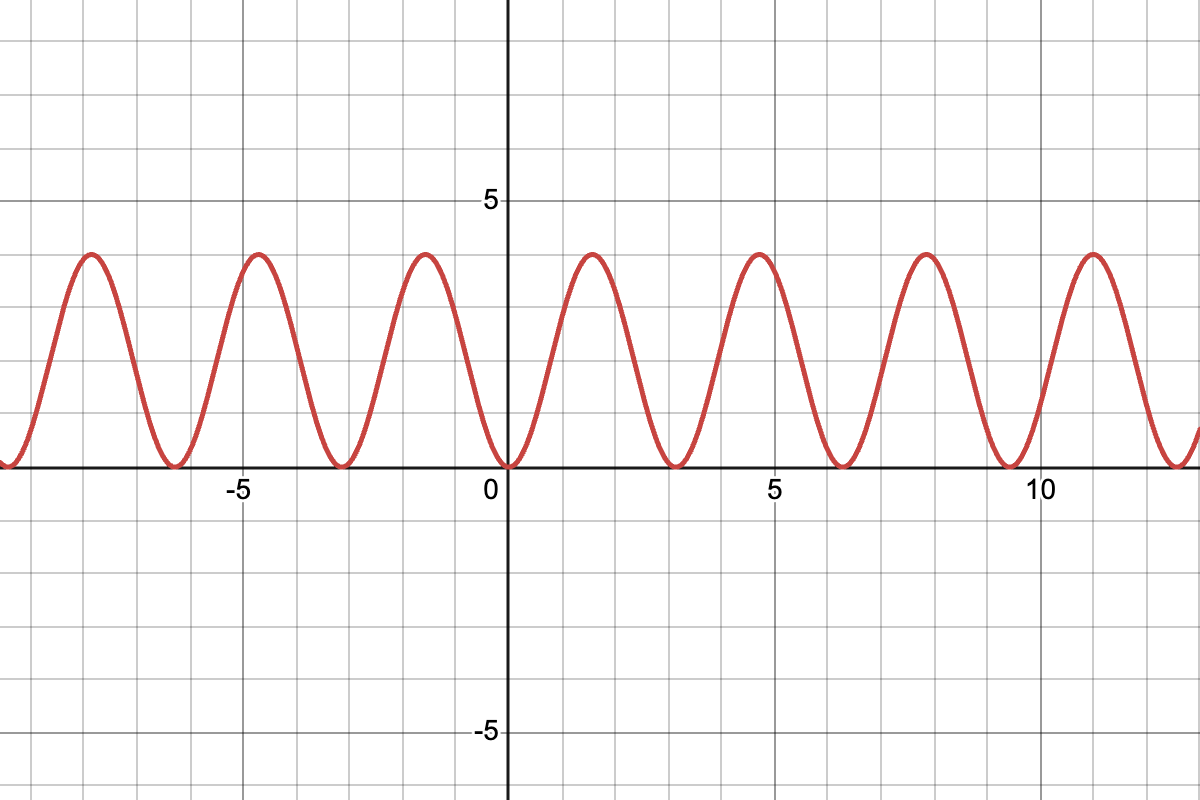
And just for fun, let’s plot the function!
Plot of $y=4\sin^2 x$