Pre-Calculus Study Guide
Brody Reid —
Right Triangle Trigonometry
SOH CAH TOA
For a right triangle with angle $\theta$, opposite side $O$, adjacent side $A$, and hypotenuse $H$:
\[ \begin{align} \sin \theta &= \frac{O}{H} \quad \text{(SOH)} \\[0.5em] \cos \theta &= \frac{A}{H} \quad \text{(CAH)} \\[0.5em] \tan \theta &= \frac{O}{A} \quad \text{(TOA)} \end{align} \]Example: A ladder leans against a wall making a $60^\circ$ angle with the ground. If the ladder is $10$ m long, how high up the wall does it reach?
The wall is opposite to the angle and the ladder is the hypotenuse, so we use SOH: $\sin 60^\circ = \frac{O}{10}$. Since $\sin 60^\circ = \frac{\sqrt{3}}{2}$, we get $O = 10 \cdot \frac{\sqrt{3}}{2} = 5\sqrt{3} \approx 8.66$ m.
Unit Circle
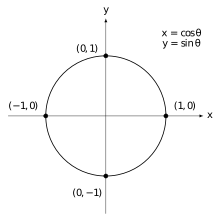
Example 1: What is the value of $\cos \pi$?
At $\theta = \pi$ (or $180^\circ$), we are halfway around the circle at the point $(-1,0)$. Since $\cos \theta$ is the $x$-coordinate, $\cos \pi = -1$.
Example 2: What is the value of $\sin 2\pi$?
At $\theta = 2\pi$ (or $360^\circ$), we complete a full revolution and return to the starting point: $(1,0)$. Since $\sin \theta$ is the $y$-coordinate, $\sin 2\pi = 0$. Note: the unit circle is periodic — the values repeat every $2\pi$, so $\sin(\theta) = \sin(\theta + 2n\pi)$ for any integer $n$.
Special Triangles
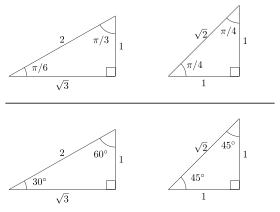
Example 1: Find the exact value of $\sin(45^\circ)$.
From the 45-45-90 triangle, the side opposite $45^\circ$ is $1$ and the hypotenuse is $\sqrt{2}$. So $\sin(45^\circ) = \frac{1}{\sqrt{2}} = \frac{\sqrt{2}}{2}$.
Example 2: Find the exact value of $\cos(\pi/6)$.
From the 30-60-90 triangle, the side adjacent to $\pi/6$ (or $30^\circ$) is $\sqrt{3}$ and the hypotenuse is $2$. So $\cos(\pi/6) = \frac{\sqrt{3}}{2}$.
Trigonometric Identities
Reciprocal Functions
\[ \begin{align} \csc x &= \frac{1}{\sin x} \\[0.5em] \sec x &= \frac{1}{\cos x} \\[0.5em] \cot x &= \frac{1}{\tan x} = \frac{\cos x}{\sin x} \end{align} \]Pythagorean Identities
\[ \begin{align} \cos^2x + \sin^2x &= 1 \\[0.5em] \sec^2x - \tan^2x &= 1 \\[0.5em] \csc^2x - \cot^2x &= 1 \end{align} \]Sum & Difference Formulas
\[ \begin{align} \sin(x \pm y) &= \sin x \cos y \pm \cos x \sin y \\[0.5em] \cos(x \pm y) &= \cos x \cos y \mp \sin x \sin y \\[0.5em] \tan(x \pm y) &= \frac{\tan x \pm \tan y}{1 \mp \tan x \tan y} \end{align} \]Example: Find the exact value of $\sin(75^\circ)$.
Write $75^\circ = 45^\circ + 30^\circ$ and apply the sum formula: $\sin(45^\circ + 30^\circ) = \sin 45^\circ \cos 30^\circ + \cos 45^\circ \sin 30^\circ = \frac{\sqrt{2}}{2} \cdot \frac{\sqrt{3}}{2} + \frac{\sqrt{2}}{2} \cdot \frac{1}{2} = \frac{\sqrt{6} + \sqrt{2}}{4}$.
Double Angle Identities
\[ \begin{align} \sin(2x) &= 2\sin x \cos x \\[0.5em] \cos(2x) &= \cos^2x - \sin^2x \\ &= 2\cos^2x - 1 \\ &= 1 - 2\sin^2x \\[0.5em] \tan(2x) &= \frac{2\tan x}{1 - \tan^2x} \end{align} \]Inverse Trig Functions
If you need to solve for the angle, take the inverse trig function of both sides. The inverse “undoes” the original function to recover the angle.
\[ \sin(\textcolor{red}{\theta}) = x \iff \sin^{-1}(x) = \textcolor{red}{\theta} \]\[ \sin^{-1}(x) = \arcsin(x)\\[0.5em] \cos^{-1}(x) = \arccos(x)\\[0.5em] \tan^{-1}(x) = \arctan(x) \]Example 1: Solve for $\theta$ in $\sin \theta = 1$.
Take $\sin^{-1}$ of both sides: $\cancel{\sin^{-1}}(\cancel{\sin}\, \theta) = \sin^{-1}(1)$. Now $\sin^{-1}(1)$ is asking, "what angle has a sine of $1$?" That's $\frac{\pi}{2}$, so $\theta = \frac{\pi}{2} = 90^\circ$.
Example 2: Solve for $\theta$ in $\cos \theta = \frac{\sqrt{3}}{2}$.
Take $\cos^{-1}$ of both sides: $\cancel{\cos^{-1}}(\cancel{\cos}\, \theta) = \cos^{-1}\!\left(\frac{\sqrt{3}}{2}\right)$. Now $\cos^{-1}\!\left(\frac{\sqrt{3}}{2}\right)$ is asking, "what angle has a cosine of $\frac{\sqrt{3}}{2}$?" That's $\frac{\pi}{6}$, so $\theta = \frac{\pi}{6} = 30^\circ$.
Logarithms
Remember that $\log_b(x)$ is asking, “$b$ to the power of what gives me $x$?”
\[ b^{\textcolor{red}{y}} = x \iff \log_b (x) = \textcolor{red}{y} \]\[ \begin{align} \log \left(M^k\right) &= k \log(M)\\[0.5em] \log (\mathit{MN}) &= \log (M) + \log (N)\\[0.5em] \log \left(\frac{M}{N}\right) &= \log(M) - \log(N) \end{align} \]Example: What does $\log_2(8)$ equal?
We ask, "$2$ to the power of what gives me $8$?" Well $2^{\textcolor{red}{3}} = 8$, so $\log_2(8) = 3$.
Example: Expand $\log_3\!\left(\frac{x^4}{y}\right)$.
Apply the quotient rule, then the power rule: $\log_3\!\left(\frac{x^4}{y}\right) = \log_3(x^4) - \log_3(y) = 4\log_3(x) - \log_3(y)$.
Example: Solve $2^x = 10$.
Take $\log_2$ of both sides: $x = \log_2(10)$. Using the change-of-base formula: $x = \frac{\ln 10}{\ln 2} \approx 3.32$.